Carpets and rugs in Singapore homes sit in humid air all year. The Meteorological Service puts the mean annual relative humidity at around 82%, and a rug that looked spotless six months ago can start smelling musty. This guide covers how to stay ahead of it: what to do at home, when to call a professional, and how to choose one that won't make things worse. If you already know you want a deep clean, our carpet and rug cleaning service page has the fixed prices by size and online booking.
Carpet vs rug, and why it matters for cleaning
Most people use the words interchangeably, but for cleaning purposes they're different problems.
- Carpets are typically wall-to-wall, fixed in place, and can't be moved or rotated. Cleaning has to happen on-site.
- Rugs are loose, movable, and often made from more delicate materials (wool, silk, synthetic blends). They can be cleaned in place or taken away.
The difference matters because method choice depends on what you have. A wool oriental rug can't take the same treatment as synthetic wall-to-wall carpet. Always identify what you have before deciding how to clean it. Checking the manufacturer label or backing tag is the safest start.
How often should you clean carpets and rugs in Singapore?
The Carpet and Rug Institute, a US trade body, advises a professional deep clean every 12 to 18 months. Dust mites like humidity above 50%, says the Asthma and Allergy Foundation of America, and Singapore's air is well above that. So we treat 12 months as the longest gap here, and suggest a shorter one with children, pets or allergies at home.
| Household type | Vacuum | Deep clean |
|---|---|---|
| Adult, no allergies, no pets | Weekly | Every 12 months |
| Family with young children | 2× per week | Every 6 months |
| Allergy or asthma sufferer | 2× per week (HEPA) | Every 6 months |
| Pet on the carpet/rug | 2× per week | Every 6 months |
| High-traffic entryway rug | Weekly + flip monthly | Every 6 months |
Looking after an area rug at home between deep cleans
Area rugs are the easiest soft floor covering to handle yourself, because they can be moved, beaten, and even rinsed, unlike wall-to-wall carpet. Here's a simple routine. Only synthetic rugs get the wet steps:
- Take it outside. The HDB corridor, balcony, or void deck works. Beat both sides with a stick or rug beater for 3–5 minutes per side. You'll be shocked how much dust comes out.
- Vacuum both sides thoroughly. Dust collects under the rug as well as in the pile.
- Spot-test cleaner on a hidden corner first. Wool, silk, viscose and jute rugs should not be rinsed at home, so stop here for those, and never use bleach or hot water on them. Synthetic rugs handle most upholstery cleaners.
- Cold-water rinse with gentle agitation. Synthetic rugs only. Use a soft brush and work in the direction of the pile. Leave no soap behind: the Carpet and Rug Institute notes that detergent residues may cause rapid soiling.
- Hang to dry in shade with airflow. Direct sun can fade the colours. Run a fan or the aircon until the rug is fully dry. The US Environmental Protection Agency says to dry wet items within 24–48 hours to prevent mould growth.
If the rug is wool, viscose, jute, or larger than about 1.5m × 2m, skip the rinse and book a professional. The risk of permanent fibre damage from amateur cleaning exceeds the cost of a proper extraction. Same goes for any rug with set-in pet urine or smoke odour, which a household cleaner rarely shifts. Two cases need a different specialist. An antique or hand-knotted silk rug usually belongs with an off-site rug washer, and a rug with visible mould needs a mould remediation specialist. Upward cleans in homes only and does not treat mould.
The 4 cleaning methods (and which one you need)
There are four real methods used by reputable cleaners in Singapore. The right one depends on the fabric, the soiling level, and how delicate the rug is.
Vacuuming
Removes dry dust and surface debris. Essential weekly maintenance, but vacuuming alone does not remove all dust mites and their waste, says the Asthma and Allergy Foundation of America.
Spot cleaning
For new stains. Blot (don't rub) with cold water and a tiny amount of mild dish soap. Test in a hidden corner first. Stop if dye transfers, and call a pro before you make it worse.
Water extraction
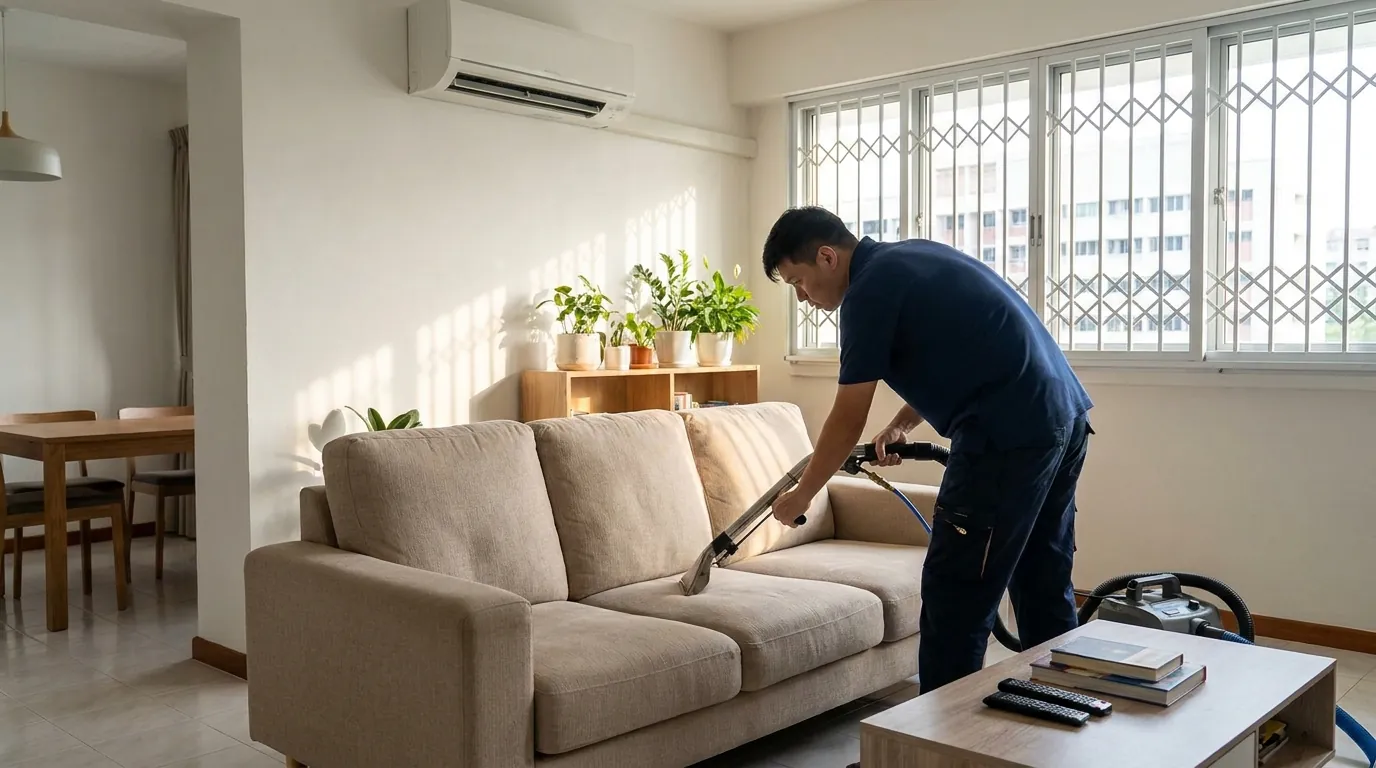
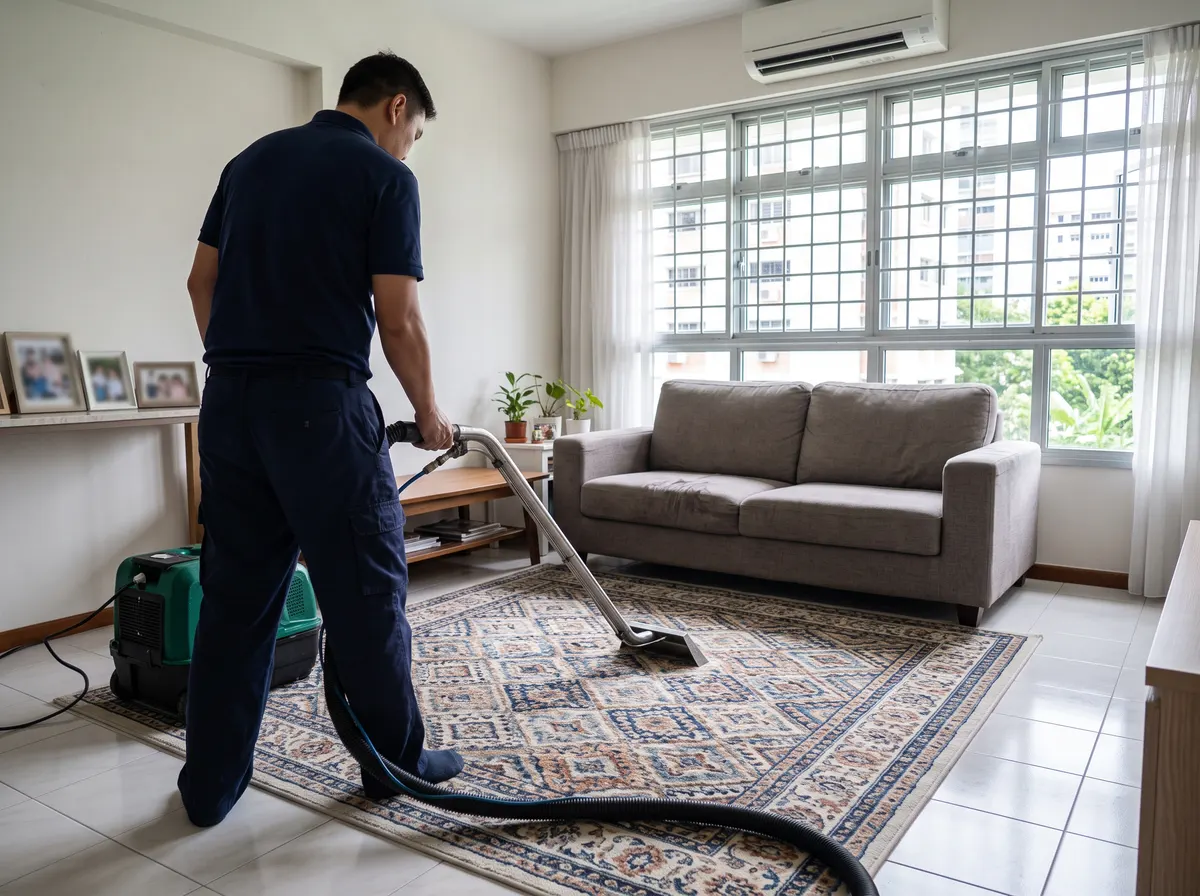
The usual professional method for synthetic and most fabric carpets/rugs. Water is sprayed into the pile, then immediately vacuumed back out, taking the loosened dirt with it. Upward does this with room-temperature water and ends with a clear-water rinse.
Dry compound / encapsulation
For wool, silk, and delicate rugs that can't tolerate water saturation. A specialised compound is brushed in and vacuumed out, with very little water.
Be careful with supermarket "carpet shampoo" machines. The two things to watch are detergent and water left in the carpet. The Carpet and Rug Institute notes that detergent residues may cause rapid soiling, and the US Environmental Protection Agency says to dry wet items within 24–48 hours to prevent mould growth. A professional extraction that ends with a clear-water rinse and a dry pass takes both back out.
How to choose a carpet or rug cleaner in Singapore
Good services and bad services both call themselves "professional." These five questions separate them quickly:
What to ask before you book
- "Do you do a clean-water rinse pass?" If no, there's detergent left in your fabric after they leave.
- "What method do you use for wool / silk / delicate rugs?" If they say "the same as everything," walk away. Different fabrics need different methods.
- "Will my carpet be safe for kids and pets to use afterwards?" A confident answer should mention what sanitiser they use and that drying is the only wait period.
- "How long until it's fully dry?" A reasonable answer for water extraction is 5 to 7 hours with a fan or the aircon on, which is what most of our own jobs take. A thick wool pile can take up to a day. If the answer is "a few days," ask how much water they use.
- "Do you give a fixed quote or charge by the square metre?" Both are valid; ambiguity isn't. Upward's prices are fixed by size.
Stain quick reference
For fresh spills, fast action helps. Our step-by-step guide to cleaning a carpet at home has a stain picker for the first five minutes. Here's what actually works on the most common stains in Singapore homes:
| Stain | Treatment | Notes |
|---|---|---|
| Coffee, tea | Cold water + mild dish soap | Blot straight away. Skip the hot water. |
| Food, oil | Bicarb to absorb oil first, then dish soap | Vacuum the bicarb after 15 min. |
| Wine, red sauce | Cold water + mild dish soap | Don't rub. Keep blotting until liquid is clear. |
| Pet urine | Pet stain and odour remover made for carpets | Blot up as much as you can first. Soaked-in pee usually needs a pro. |
| Vomit | Remove solids → bicarb → cold water | Work outside-in to avoid spreading. |
| Blood, ink | Cold water only / call a pro | Set-in stains rarely come out at home. |
What a carpet or rug deep clean costs by size
Upward prices rugs and carpets in fixed size bands, so you know the price before you book. It is the same for HDB flats, condos and landed homes.
| What you have | Upward price |
|---|---|
| Rug (1m × 1.5m) | from S$90 |
| Carpet that fits within 1m × 1m | S$95 |
| Carpet that fits within 2m × 2m | S$130 |
| Carpet that fits within 3m × 3m | S$150 |
| Carpet that fits within 4m × 4m | S$170 |
| Carpet bigger than 4m × 4m, or another rug size | Quote on WhatsApp |
Book the smallest size your carpet fits within. A 2.4m × 1.8m carpet is longer than 2m, so it books as 3m × 3m at S$150. Only a carpet bigger than 4m × 4m, or a rug in another size, needs a quote: send the measurements on WhatsApp and we reply with a fixed price. The minimum job is S$50, which every size above already clears.
Check our carpet and rug cleaning prices by size to add up your own pieces and book online, or see the full price list on the services page. For what moves a rug quote up or down, read our rug cleaning cost guide.