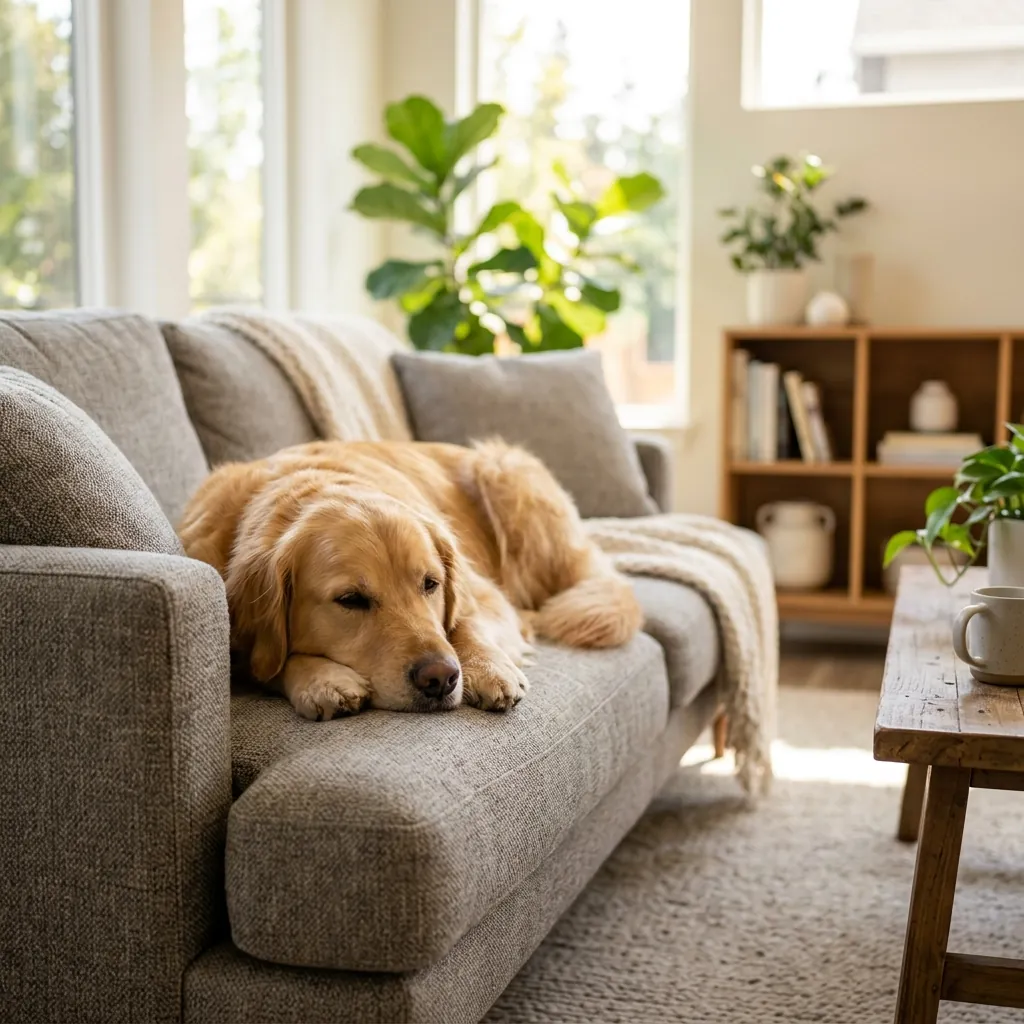
Anyone who's had a baby or brought home a puppy in Singapore has asked some version of the same question: is this product, spray, cleaning agent actually safe for them? You check the packaging, you Google the ingredients, and if you still can't tell – you default to not using it.
But when a cleaning company walks into your flat with industrial-grade detergents and sanitisers, that same scrutiny often goes out the window. The truth is that "professional cleaning" is not automatically safer than anything you'd find on a supermarket shelf. In many cases it uses more aggressive chemistry, and the residue stays right where your child is about to put their face.
This guide is about one specific thing: the chemical residue left behind by most sofa and upholstery cleaning in Singapore, who it affects, and how zero-residue cleaning actually works. It's also the reason we built our whole business around it.
The hidden problem with most sofa cleaning
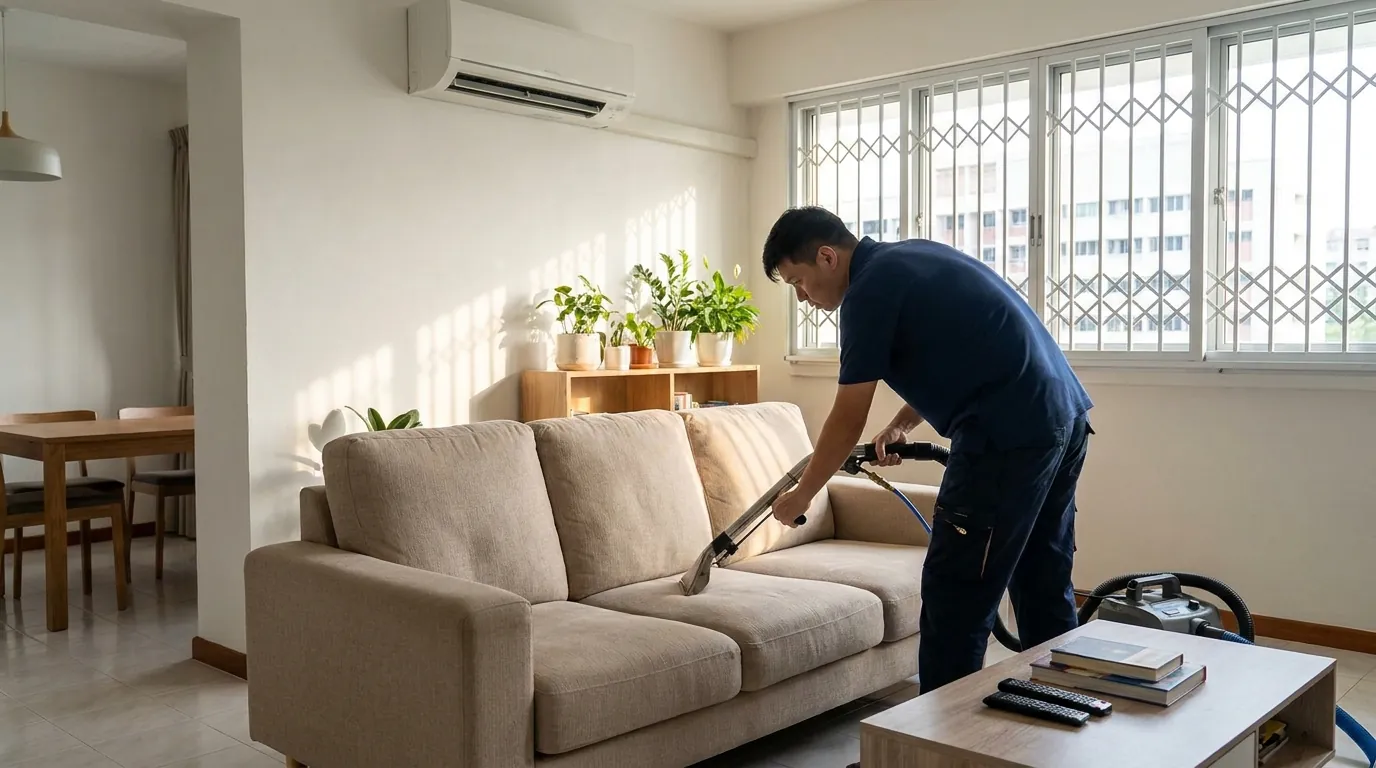
Here's what a typical sofa clean looks like, simplified: a cleaning solution is sprayed onto the fabric, worked in, then the sofa is either wet-vacuumed, dry-vacuumed, or just left to air dry. The stains are gone. The sofa looks great. The customer is happy.
The issue is what you don't see. Cleaning solutions are designed to be effective – they contain surfactants, solvents, and sometimes disinfectants. Vacuuming removes the liquid, but it does not remove every molecule of chemistry that has bonded to the fabric fibres. When the sofa "dries", those compounds are still there, held in the fabric. In some cases they continue to off-gas. In others, they reactivate with heat, humidity, or moisture from sweat and skin contact.
This is fine for most adult users most of the time. An adult with normal skin doesn't notice. An adult without allergies isn't bothered. The problem is that "most users most of the time" isn't the group we need to worry about.
Who's most at risk (and why it's not just babies)
Four groups interact with a sofa fundamentally differently than a typical adult, and each of them bears the brunt of residue-heavy cleaning:
Babies and crawling toddlers
A baby's skin is 30% thinner than an adult's, with a weaker barrier function. That means whatever is on the sofa surface – residual detergent, sanitiser, fragrance compounds – gets absorbed faster and irritates more easily. Crawling toddlers make direct hand-and-face contact with upholstery for hours a day, then put those hands in their mouths. Any residue becomes an ingestion path.
Pets
Dogs and cats lick everything, including themselves after they've been sleeping on the sofa. They also absorb compounds through paw pads, which are surprisingly permeable. Many standard sofa-cleaning sanitisers are technically fine for humans but specifically flagged as unsafe for pets – especially cats, who metabolise many chemicals differently. If your cleaner doesn't know this, they'll use whatever's standard.
Asthma and eczema sufferers
Residual fragrance and sanitiser compounds are among the top indoor triggers for atopic dermatitis flares and asthma in the region. A "fresh-smelling" sofa is often a red flag, not a green one – strong fragrance means lots of compound clinging to the fabric, which means lots of inhalation and skin contact.
Anyone with sensitive skin
If you've ever developed a mysterious rash on the back of your legs or arms after a sofa clean, you've experienced residue contact dermatitis. It usually fades on its own but clearly tells you something is still in the fabric.
What "zero residue" actually means (not just marketing)
"Zero residue" has become a buzzword, so it's worth being precise about what it technically means and what it doesn't:
- It does not mean "no chemicals were used." Some sanitisation still requires effective cleaning agents. The question is whether they stay in the fabric afterward.
- It does not mean "eco-friendly" or "natural." Those are separate claims. You can have residue-heavy eco products and residue-free synthetic ones.
- It specifically means a final clean-water rinse pass using water extraction – injecting plain water into the fabric, then immediately vacuuming it out to remove any remaining cleaning agent along with it.
The physics of it is straightforward. Cleaning agents are water-soluble (otherwise they couldn't be rinsed off your hands). Running additional clean water through the fabric and then extracting it takes those agents with it. One rinse pass cuts residue dramatically. Two or more passes gets you effectively to zero.
Our cleaning agents are bio-enzymatic (pet-safe) for pre-treatment, and our sanitiser is a hospital-grade hypochlorous acid solution – the same chemistry used to sanitise infant feeding equipment. Every clean includes a clear-water rinse pass, then a light protective sanitising pass to finish. Nothing we use requires a warning label for children or pets.
The 5 questions to ask any sofa cleaner before you book
If you're booking a cleaner in Singapore – us or anyone else – these are the questions that separate a genuinely safe service from a "we tell customers what they want to hear" service:
Why this matters more in Singapore than elsewhere
Residue issues get amplified in Singapore for reasons unique to our climate:
- Constant humidity keeps residue active longer. A compound that would off-gas in 24 hours in a dry climate might linger 3–5 days here.
- Homes are smaller and more enclosed. HDB flats and condos don't have the ventilation volume of a suburban house. Off-gassing compounds concentrate faster indoors.
- Aircon recirculation means those compounds cycle through your living space repeatedly rather than dissipating.
- Moisture plus sugar/protein residue (from sweat, food, pet dander) plus cleaning-agent residue is a recipe for bacterial and mould growth. Counter-intuitively, a heavily-cleaned-but-residue-heavy sofa can end up more contaminated within weeks than a well-cleaned zero-residue sofa.
This is the main reason we built zero-residue into our process from day one – not as a bolt-on upgrade but as the default for every job.
Our pet & baby safe process
Every sofa, mattress, and upholstery clean we do follows the same five-step process. Nothing we use requires a "keep away from children" warning, and no step leaves harsh chemistry in the fabric after we're done.
Assessment & pre-treatment
We identify stains, odour sources, and any sensitive areas. A pet-safe bio-enzymatic spray breaks down organic matter – sweat, body oils, pet dander, food stains. Enzymatic means it digests the material rather than dissolving it with harsh chemistry.
Deep water extraction
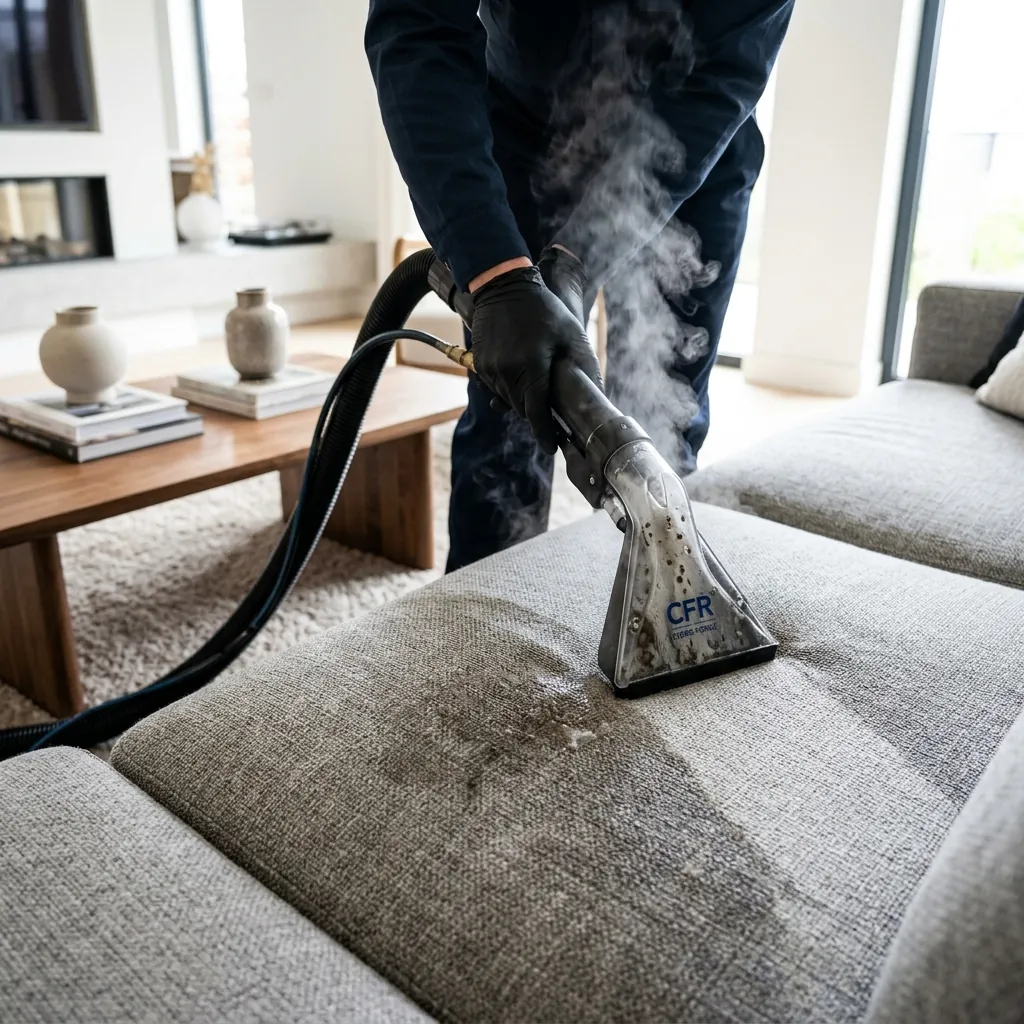
Industrial extraction injects water into the fabric under pressure, then immediately vacuums it back out along with everything it has loosened. This reaches deep into the fibres where dust, allergens, and organic buildup live.
Baby & pet safe sanitisation
A hospital-grade sanitiser – hypochlorous acid, the same chemistry used on infant feeding bottles and veterinary equipment – is applied. It kills bacteria, viruses, and mould spores, then naturally degrades into saline. No phenols, no quaternary ammonium, no fragrances.
Zero-residue rinse pass
A dedicated pass with clean water only. We inject plain water through the fabric and extract it out – physically removing any remaining cleaning or sanitising agent. The result: a sofa that's demonstrably clean, with no cleaning agent left behind.
Protective sanitising pass
Lastly, we apply hospital-grade sanitisation again at the end of the cleaning, leaving a protective film that may last up to 30 days. All our solutions are child and pet friendly.
Most sofas dry within 4–6 hours under normal fan or aircon ventilation. Your baby or pet can use it as soon as it's dry. Nothing is left in the fabric to off-gas, and the finishing sanitiser is child and pet safe. The same rinse is used on baby gear, and our stroller cleaning guide shows what that looks like on a stroller. See our pet and baby-safe cleaning prices – 3-seater sofas from S$105.