Leather isn't fabric – it's a treated animal hide, and it ages the way skin ages. In Singapore that ageing happens faster than most owners expect because we run aircon almost every day, which strips the oils that keep leather supple. This guide is the short, practical version of our full leather sofa cleaning guide: a daily / weekly / monthly routine that takes about ten minutes a month and adds years to the sofa.
Daily – small habits that protect the finish
The damage that ages a leather sofa fastest in Singapore is usually invisible day to day. A few habits prevent most of it:
- Keep sharp things off the seat. Keys, watches, belt buckles and ballpoint pens scratch the protective top coat. Once that coat is broken, dye lifts and moisture gets in.
- Don't sit in damp clothes. After a rainy commute, change first. Leather absorbs moisture through the seams faster than the surface, and trapped damp is what breeds mould behind the cushions.
- Watch where the AC vent points. A vent blowing directly onto leather dries it 24/7. If you can feel air on the seat when the aircon is on, redirect the louvres.
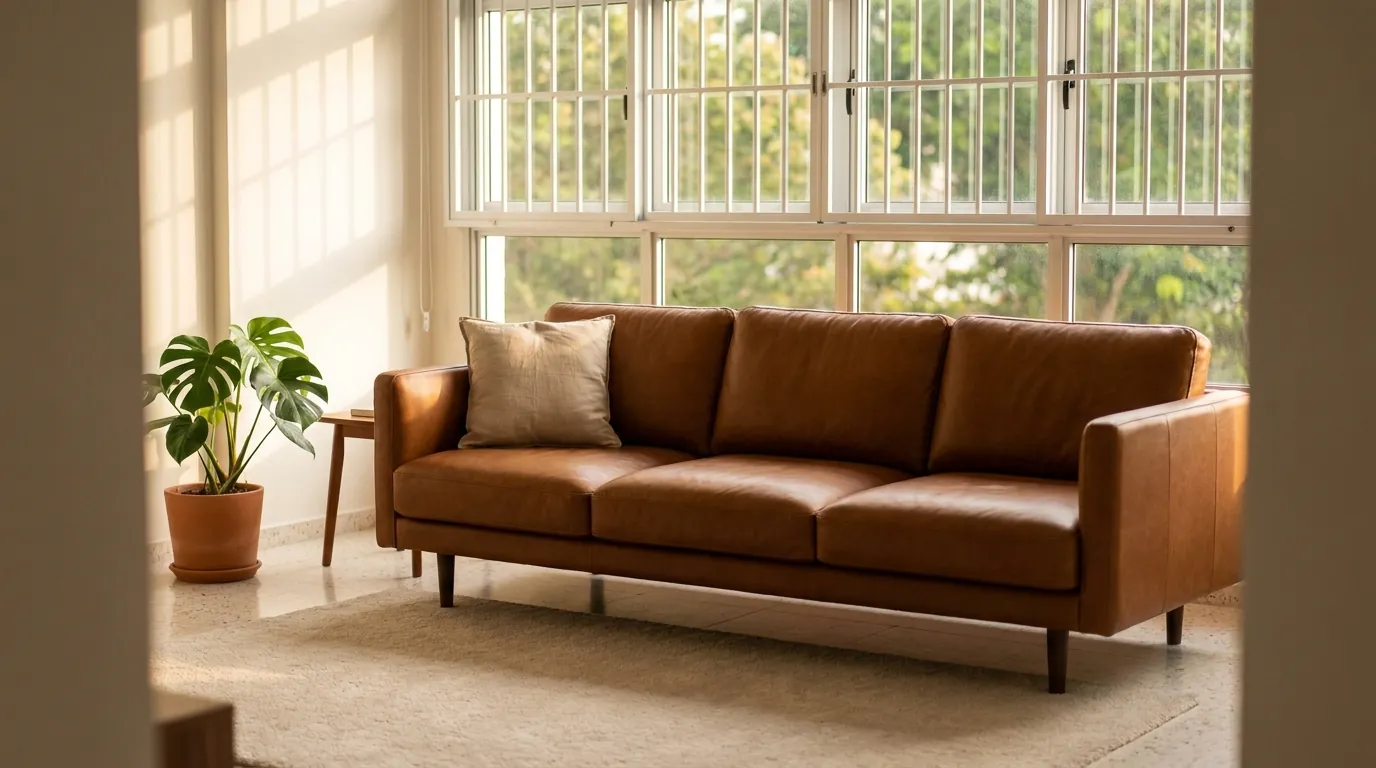
- Block direct sun. Window grille shadows look great in photos, but the actual sunlight underneath fades dye and stiffens the hide. A sheer curtain is enough.
Weekly – a five-minute vacuum
This is the single most important habit if you want to maintain a leather sofa rather than rescue it. Grit – sand from shoes, biscuit crumbs, pet dander – sits in the seams and under the cushions, then gets ground into the surface every time someone sits down. After a year of that, leather looks "tired" even though nothing visible is wrong.
The 5-minute weekly routine
- Lift each cushion and vacuum the well underneath.
- Use the soft brush nozzle on low suction. The hard nozzle scratches; high suction can lift the piping.
- Run along every seam and piping line. This is where the worst grit collects.
- Vacuum the back and sides too – not just the seat. The back is where mould starts because airflow is worst there.
Monthly – wipe and (every 3–6 months) condition
Once a month, give the sofa a damp wipe with a well-wrung microfibre cloth and distilled water (tap water leaves mineral deposits in the seams). Wipe in straight lines, then immediately dry with a second cloth. No detergent. No supermarket "leather cleaner spray" – most are alcohol-based and they're the reason older sofas look patchy.
Conditioning is the part most owners skip and then regret. In a dry climate you might condition leather once a year; in Singapore, an aircon-heavy home strips moisture faster, and most sofas benefit from a pH-neutral leather conditioner every 3–6 months. Use sparingly – a pea-sized amount per cushion, worked in with a microfibre cloth in small circles, then buffed off.
| Action | How often (Singapore) | Why it matters |
|---|---|---|
| Vacuum with soft brush | Weekly | Removes grit before it abrades the finish. |
| Damp microfibre wipe | Monthly | Lifts skin oils, dust and food residue. |
| Condition with leather-safe cream | Every 3–6 months | Replaces oils stripped by aircon. |
| Professional clean & condition | Every 6–12 months | Deep-clean, deep-condition, mould check. |
Things people use on leather that quietly wreck it
If a leather sofa is failing prematurely, the cause is almost always on this list. None of these are obvious – they all look like helpful cleaning at first.
- Vinegar and water sprays. The most popular question we get is "how to clean leather sofa with vinegar" – the honest answer is don't. Vinegar is acidic; the top coat on pigmented leather is pH-sensitive. Repeated vinegar wipes etch the finish and create dull patches you can't polish back.
- Alcohol wipes & hand sanitiser. Both dissolve the protective finish. Damage usually shows after a year as a smoother, shinier patch where the wipes touched.
- Baby wipes. Mild on skin, harsh on leather. The surfactants and propylene glycol leave a waxy film that attracts dust and slowly degrades the coating.
- Steam cleaners. Steam softens the top coat and can permanently distort the finish. If a "sofa cleaner" offers steam for leather, book someone else.
- All-purpose spray cleaner. Designed for plastic, glass and laminate – none of which behave like leather. The detergent strips oils.
- Direct sun and AC vents. Not products, but they belong on this list. They damage leather faster than most chemicals.
When DIY isn't enough – signs you need a professional clean
A maintenance routine handles 90% of leather care. The other 10% is when something has already gone wrong, and the fastest way to make it worse is to keep DIYing. Stop and book a professional when you see any of the following:
- Sticky or tacky patches where the surface used to be smooth – usually residue from a previous DIY clean that needs neutralising.
- Dull, matte sections next to still-glossy ones – the top coat is uneven and needs reconditioning before it cracks.
- Pen marks, food stains or dye transfer older than 24 hours – these need specialist agents, not hairspray or alcohol.
- Musty smell from behind the cushions – mould has started in the foam or backing, which a surface wipe won't reach.
- It's been over 12 months since the last professional clean – even with perfect maintenance, oils need replenishing.
Our leather sofa cleaning service covers all of the above – a full clean plus moisturise in 60–90 minutes, zero residue, touch-dry within 30 minutes. Armchairs from S$110, 2-seaters S$140, 3-seaters S$160.