Type "steam cleaning singapore" into Google and you'll find dozens of services advertising it for sofas, mattresses, carpets, and curtains. Most of those services don't actually use steam – at least not the way the word is technically defined. They use water extraction and call it steam cleaning because that's what customers search for. The confusion is harmless until it isn't: there are situations where you genuinely want one method over the other, and not knowing the difference can leave you with a worse clean, a damp sofa, or a wool rug that's been ruined.
This guide untangles the two methods, explains when each is genuinely the right tool, and gives you the questions to ask a Singapore cleaner so you actually know what's about to happen to your furniture.
What "steam cleaning" actually means
Technically, steam is water vapor heated above its boiling point – invisible to slightly visible mist, no liquid phase. A genuine steam cleaner uses a sealed boiler to produce this vapor at high temperature (usually 100–180 °C) and pushes it out through a nozzle. Nothing else comes out: no detergent, no cold water, no rinse. The heat alone is what does the work – it sanitises by killing bacteria, dust mites, and most viruses on the surface the steam touches.
That's it. There's no extraction. No water is injected into the fabric. The steam condenses into a tiny amount of moisture on the surface, which evaporates fast in the heat.
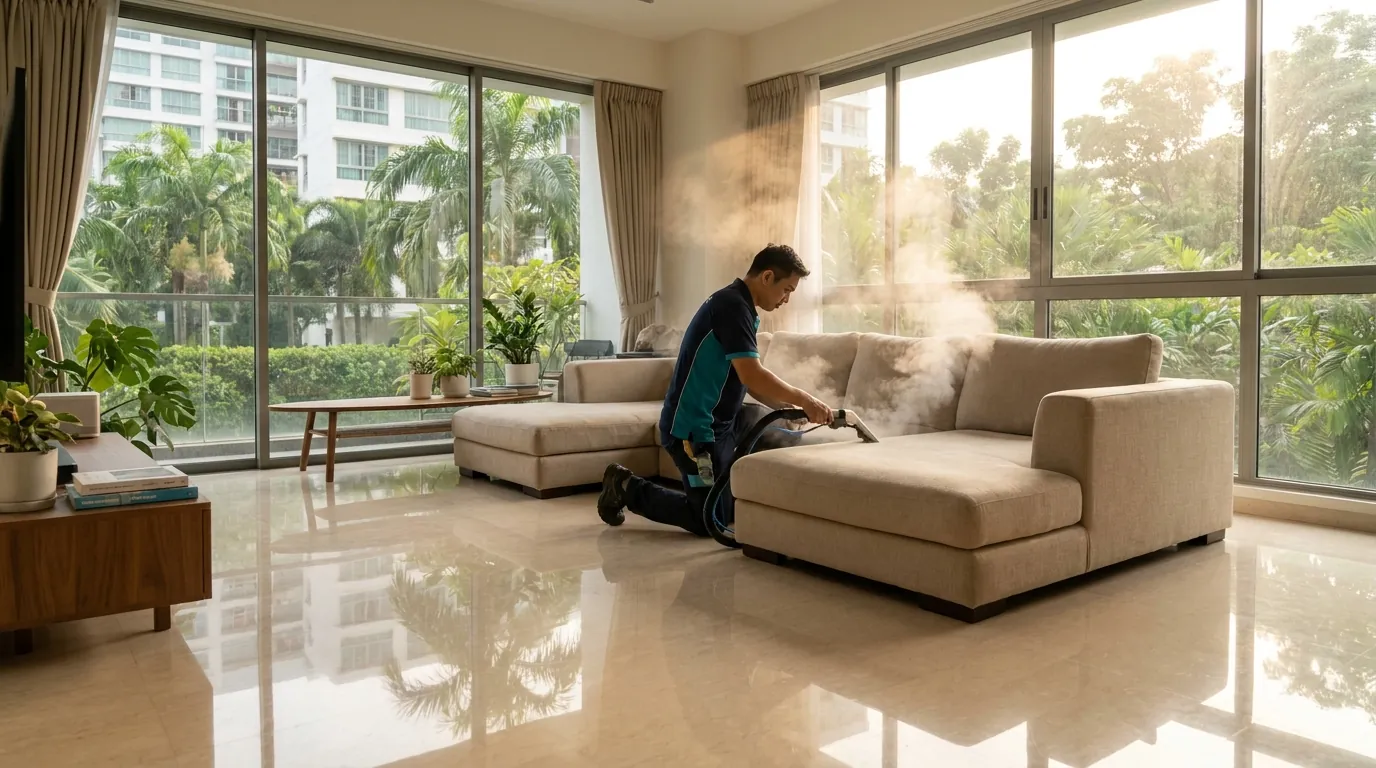
The trouble starts because almost every cleaning company in Singapore that advertises "steam cleaning" for soft furnishings – sofas, mattresses, carpets – is actually doing something different. They're doing water extraction, which sometimes produces visible steam from the heat, but is fundamentally a wet-cleaning process. The category names got blurred in marketing, and now most consumers use "steam" and "extraction" interchangeably even though they're different techniques.
Steam cleaning vs water extraction – the real difference
Here's the side-by-side that almost no one explains clearly:
True steam cleaning
Hot vapor only, no liquid injection. Sanitises the surface. Does not physically remove embedded dirt – there's no suction. Surface stays slightly damp for minutes.
Water extraction
Water (sometimes with a mild pre-spray) injected at pressure, then immediately vacuumed back out the same nozzle. Lifts dirt, dust mites, allergens, sweat, and oils. The water that comes out is dark grey.
The crucial distinction is physical removal of dirt. Pure steam can kill what it touches but it can't lift trapped grime out of cushion foam or carpet fibres – there's nothing to carry the dirt away. Water extraction does both: the water lifts and dissolves the dirt, and the vacuum extracts it.
| Property | Pure steam | Water extraction |
|---|---|---|
| Removes embedded dirt | No | Yes |
| Kills dust mites & bacteria | Yes (surface) | Yes (deep) |
| Removes dust mite allergen residue | Partially | Yes |
| Lifts stains | Light surface stains only | Most stains, including older ones |
| Dries fast | Yes (minutes) | 4–8 hours under fan/aircon |
| Safe for delicate natural fibres | Yes (with care) | Risk of shrinkage on wool/silk |
| Best for hard surfaces & grout | Yes | Overkill |
| Best for sofas, mattresses, carpets | No | Yes |
When steam cleaning IS the right choice
There are genuine cases where pure steam is the better tool – usually anywhere you want sanitisation without saturation:
- Bathroom tile grout. The heat dissolves soap scum and kills mould spores without leaving detergent residue on porous grout.
- Kitchen hard surfaces. Grease lifts off cooktops, hoods, and tile splashbacks more easily under steam than under detergent alone.
- Very delicate fabrics that can't tolerate any liquid. Vintage silk, certain hand-knotted wool rugs, and some antique upholstery sometimes need vapor-only sanitisation because extraction water would damage the dye or fibre.
- Surfaces in homes with severe chemical sensitivities. Steam uses no detergent – only heat – so it's hypoallergenic by default. The trade-off is that it doesn't actually remove the allergen residue, only the live mites.
- Quick sanitisation between deep cleans. If you've just had a sick guest sleep on the sofa, surface steam between professional deep cleans is reasonable.
Important nuance. Even when steam is appropriate, it sanitises but doesn't remove. If a dust mite dies under steam its allergen-producing droppings are still in your mattress. The carcasses and proteins are what trigger allergies – only extraction removes those.
When extraction is what you actually need
For nearly every soft furnishing in a Singapore home, water extraction is the better tool. The reason is climate: our 75–95% humidity makes embedded dirt and dust mite residue accumulate faster than in temperate climates. You don't just need to sanitise the surface – you need to physically pull the load out of the fabric. Extraction does that. Pure steam doesn't.
Extraction is what you want for:
- Sofas and fabric upholstery that have absorbed body oils, sweat, food spills, and pet dander.
- Mattresses where dust mite populations build up over years – typically 100,000 to 10 million in a used mattress, by allergist estimates.
- Carpets and rugs with embedded dirt, traffic patterns, or pet accidents that have soaked into the backing.
- Allergy-prone households where the goal is to remove the allergen, not just kill the source.
- Anything with old or set-in stains – coffee, wine, pet urine, mould patches – that surface steam can't touch.
For more on the dust mite case specifically, see our mattress cleaning guide. For the deep-dive on carpets and rugs, our complete carpet & rug cleaning guide covers method selection in more detail.
How to tell what your "steam cleaner" is really doing
The fastest way to know which method you're actually being offered is to ask the right questions before booking. Here's what separates a true steam cleaner from a water extraction service that's marketing under the "steam" label:
Five questions to ask before you book
- "Do you inject water into the fabric, or just spray vapor on the surface?" Injection = extraction. Vapor-only = true steam. Both are valid for different jobs, but you should know which you're paying for.
- "Does the machine have suction that pulls water back out?" If yes, it's extraction. If the machine has no vacuum function, it's a steam mop or steam gun.
- "Is it heated vapour, or liquid water that gets vacuumed back out?" Pure steam runs 100 °C+ at the wand and sanitises the surface only. Water extraction uses liquid water and suction to physically lift the dirt out of the fabric.
- "How long until the surface is fully dry?" Steam = minutes. Extraction = 4–8 hours under fan or aircon. If they say "24+ hours" for a synthetic sofa, the cleaner is using too much water or doesn't have proper extraction power.
- "Do you finish with a clean-water rinse pass?" This question only applies to extraction. A "yes" means no detergent residue is left in the fabric. In Singapore's humidity, residue traps new dirt and can breed bacteria – so this matters.
Sofa, mattress, carpet – which method for which surface
Different soft furnishings respond differently. Here's the practical breakdown for Singapore homes:
| Surface | Best method | Why |
|---|---|---|
| Fabric sofa | Water extraction | Body oils, sweat, and food residue are deep in the foam. Pure steam can't reach or remove them. |
| Leather sofa | Neither – wipe + condition | Both steam and extraction can damage leather. See our leather sofa care guide. |
| Mattress | Water extraction | Dust mite allergens are embedded – needs physical removal, not just sanitisation. |
| Synthetic carpet / rug | Water extraction | Lifts traffic-pattern dirt that surface steam leaves behind. |
| Wool or silk rug | Dry compound or careful steam | Hot water saturation can shrink wool or bleed silk dyes. Specialist method needed. |
| Curtains (synthetic) | Pure steam (on-site) | Lightweight fabric, no embedded dirt – surface sanitisation is enough. Our curtain washing guide sorts wash vs dry clean vs steam by fabric. |
| Tile grout, hard surfaces | Pure steam | Steam cuts soap scum and kills mould without detergent residue. |
The category confusion can cost you. If a "steam cleaner" turns up to your sofa appointment with a domestic steam mop and no extraction vacuum, you're not getting a deep clean – you're getting a surface sanitisation that won't touch the embedded dirt that made you book in the first place. Always confirm what's coming.
For most Singapore households, the practical takeaway is simple: when you book "steam cleaning" for soft furnishings, what you actually want is water extraction. Upward's standard sofa and mattress process is exactly that – water extraction with a clean-water rinse pass, finished with medical-grade sanitisation, included as standard, for nurseries and allergy-prone households.