
Leather Sofa Repair in Singapore: Repair, Restore or Just Clean?
Peeling, cracks, fading and sticky patches are different problems. Here's which ones a clean can fix, which need a leather restorer, what repairs cost, and when to stop spending on the sofa.
- A leather sofa problem in Singapore ends one of three ways: a clean and condition (S$110–S$160 with us), a repair or recolour by a leather restorer (about S$150–S$1,500), or reupholstery (about S$1,800–S$2,500 for a leather 3-seater). The repair and reupholstery figures are one Singapore workshop's published rates at the time of writing.
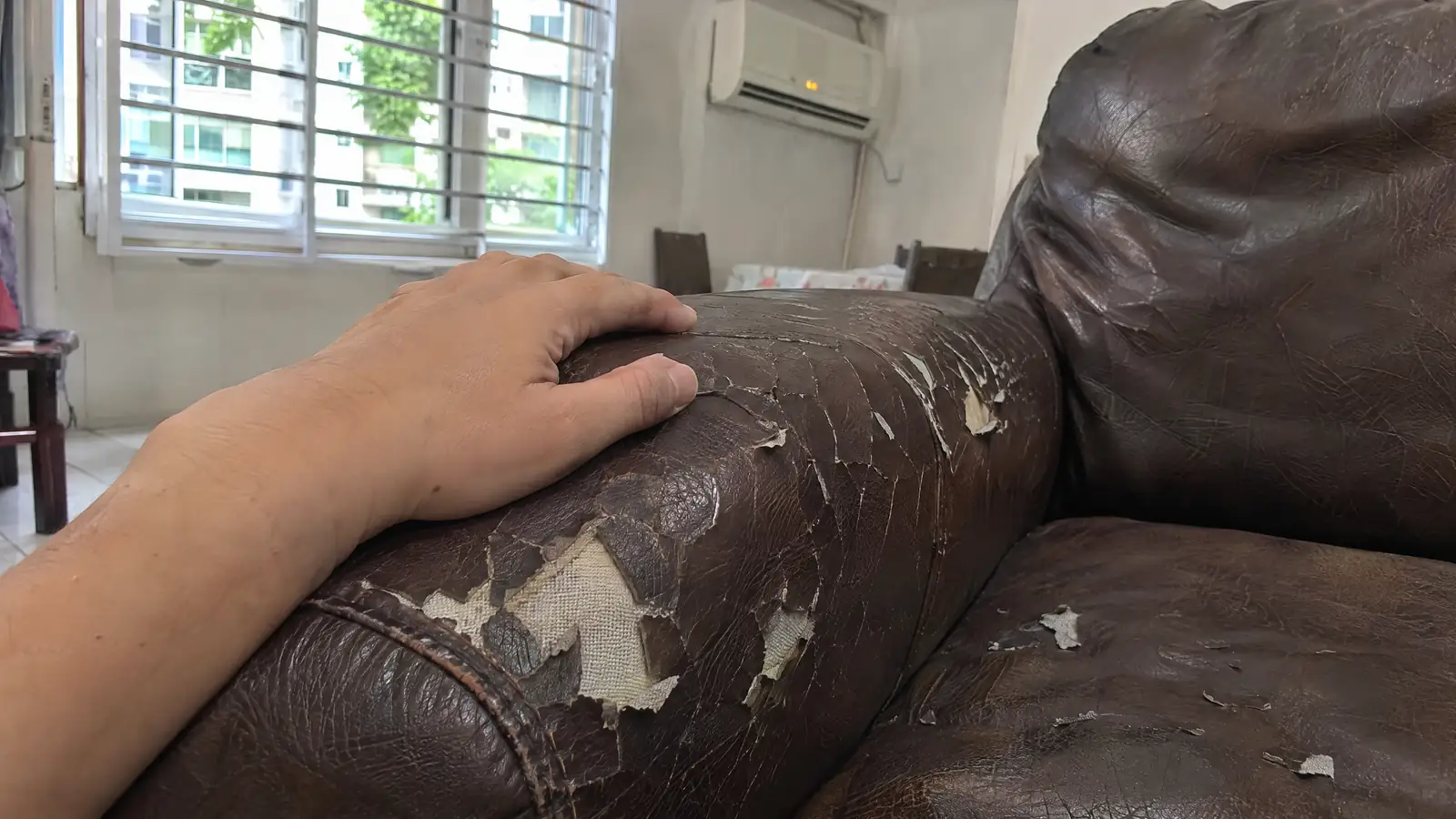
- Peeling almost always means PU or bonded leather. The coating is coming off its fabric backing, and no cleaning or conditioning can put it back.
- Cracks, fading, scratches and tears need a repair specialist. Sticky or dull patches from sweat and body oil need a clean.
- To check the material, look behind the surface. Woven fabric means PU or bonded leather. A suede-like back means genuine leather.
- Upward cleans and conditions leather. We do not repair, recolour or reupholster it.
Before you pay anyone to repair a leather sofa, work out what's actually wrong with it. A peeling armrest, a cracked seat and a sticky headrest look like one problem from across the living room. They are three. One is a S$160 cleaning job and one needs a leather restorer. The third usually can't be patched back at all, only re-covered or replaced. Here's how to tell them apart, including when we are the wrong people to call.
What's wrong with your leather sofa?
Pick what you see, then what sits behind the surface if you know it. The answer points you to a clean, a repair specialist or a replacement, and says so when we need a photo first.
Why is my leather sofa peeling?
Start with peeling, because the news is worst. Real leather does not peel or flake. What peels is bonded leather (10–20% ground leather scraps under a polyurethane skin) or faux leather (fabric with the same skin on top). When the skin lifts, you get flakes on the floor and bare cloth on the armrest.
Heat and damp air break it down. Faux-leather maker The Mitchell Group says cheaper polyurethanes fail early in high-traffic seating and in hot, humid weather. Singapore's mean annual relative humidity is around 82%.
No cleaner or conditioner will bond the skin back. One Singapore upholstery workshop states that peeling bonded or PU leather cannot be permanently repaired. That leaves re-covering it, panel by panel or the whole sofa, or buying a new one. Cleaning it would be taking your money for nothing.
How do I tell genuine leather from PU or bonded leather?
Check the paperwork first. The receipt or the tag under the seat should name the material. Words like PU, bonded, leatherette or faux settle it.
Then look at the back of the material. Unzip a seat cushion cover, or look into a crack or tear. Leather-repair supplier Rub 'n Restore says real leather shows a suede back, not microfibre or woven fabric. A thin skin over cloth is PU or bonded leather.
Still unsure? Send a close-up to whoever you plan to hire and ask them to name the material before they quote.
Do humidity and aircon really make leather crack?
They can. Leather dislikes extremes, and it dislikes swinging between them.
The Canadian Conservation Institute, which advises museums, says leather should be protected from extremes and fluctuations of relative humidity. Above 65%, mould can grow and the fibres slowly break down. Below 30%, leather loses moisture and turns brittle. It recommends a steady 45% to 55%. If mould is already growing on your sofa, we don't treat it. That is a job for a mould remediation specialist.
A Singapore living room is rarely steady. Outside air sits far above that range, and an aircon pulls moisture out of the room air whenever it runs. We haven't found a lab test of aircon on sofa leather, so take the next part as a trade view. Lion City Canvas & Upholstery, a Singapore workshop, says air conditioning dries leather out and causes cracking and stiffness. So a sofa parked right under the vent is worth moving.
Sunlight and heat do the rest. The institute notes that light damage to dyed leather builds up and cannot be reversed. Warwick Fabrics tells owners to keep leather out of direct sunlight and at least 30cm from any heat source.
How much does leather sofa repair cost in Singapore?
We don't repair leather, so the repair figures below aren't our prices. They are the rates one Singapore upholstery workshop publishes, at the time of writing. Get your own quote from photos.
Source for the repair figures: Lion City Canvas & Upholstery's leather repair price list and sofa reupholstery price list, at the time of writing. The same list has a top tier, a full restoration of a badly worn 3-seater, at S$600–S$1,500.
Other local guides give wider bands. Furniture retailer CODA puts minor repairs at S$50–S$500, major work such as re-dyeing at S$200–S$1,000 and reupholstery at S$1,000–S$4,000, at the time of writing. Megafurniture suggests replacing once a repair quote passes half the price of a comparable new sofa. Both sell sofas, so weigh that, but the half-price test is a sensible place to stop and think.
What can a clean and condition fix?
This is the part we do. We hand clean leather with a pH-balanced leather cleaner, then condition it. It's never soaked and never goes under the extraction machine we use on fabric. A 3-seater is S$160, a 2-seater S$140 and an armchair S$110, and a 3-seater takes about 1 hr 25 min on site including setup and pack-up. Our sofa cleaning page explains the method and the full price list covers every size.
What it fixes is build-up. Headrests, arms and seat fronts touch skin daily, and Furniture Clinic, a UK leather care supplier, says body oils soak in where you rest your head and arms. That film is what feels tacky and looks dull. Dye transfer is a different thing. Warwick notes that jeans and other non-colourfast clothing can cause it. A clean may lighten a new mark, but we can't promise it. Ink and dye that won't lift are a restorer's job.
What a clean does not fix: peeling, open cracks, faded colour, scratches or tears. Upward does not repair, recolour or reupholster leather, and does not treat mould. The first three jobs belong to a leather restorer or an upholstery workshop.
How do I stop the damage coming back?
Move the sofa before you spend on it. An arm that sits in the afternoon sun by the window grilles will fade again after a recolour. If the aircon blows straight onto the backrest, shift the sofa out of the airflow as well.
After that it's routine. Have the sofa cleaned and conditioned every 6 to 12 months. Warwick's guidance is to clean leather at least every six months so body oils and perspiration don't build up, and to skip saddle soap, wax polish and spray polish.
Our leather care routine has the weekly version, and the leather sofa cleaning guide lists the household products that damage the finish. Shopping for a replacement? Read the leather versus fabric comparison first, and check what the label says the cover is made of.
Frequently asked questions
Clean or repair? Send a photo.
We'll tell you straight, even when the answer is a restorer and not us. Leather clean and condition from S$110. Every online booking earns a stamp on the Upward Stamp Card.
Leather Sofa Cleaning in Singapore: Care & Common Mistakes
What leather needs, and the wipes and sprays that strip it.
Leather vs Fabric Sofa: Which Suits Your Home?
How each one holds up in humidity and aircon, with real upkeep costs.
How to Care for a Leather Sofa
The daily, weekly and monthly routine that takes ten minutes a month.