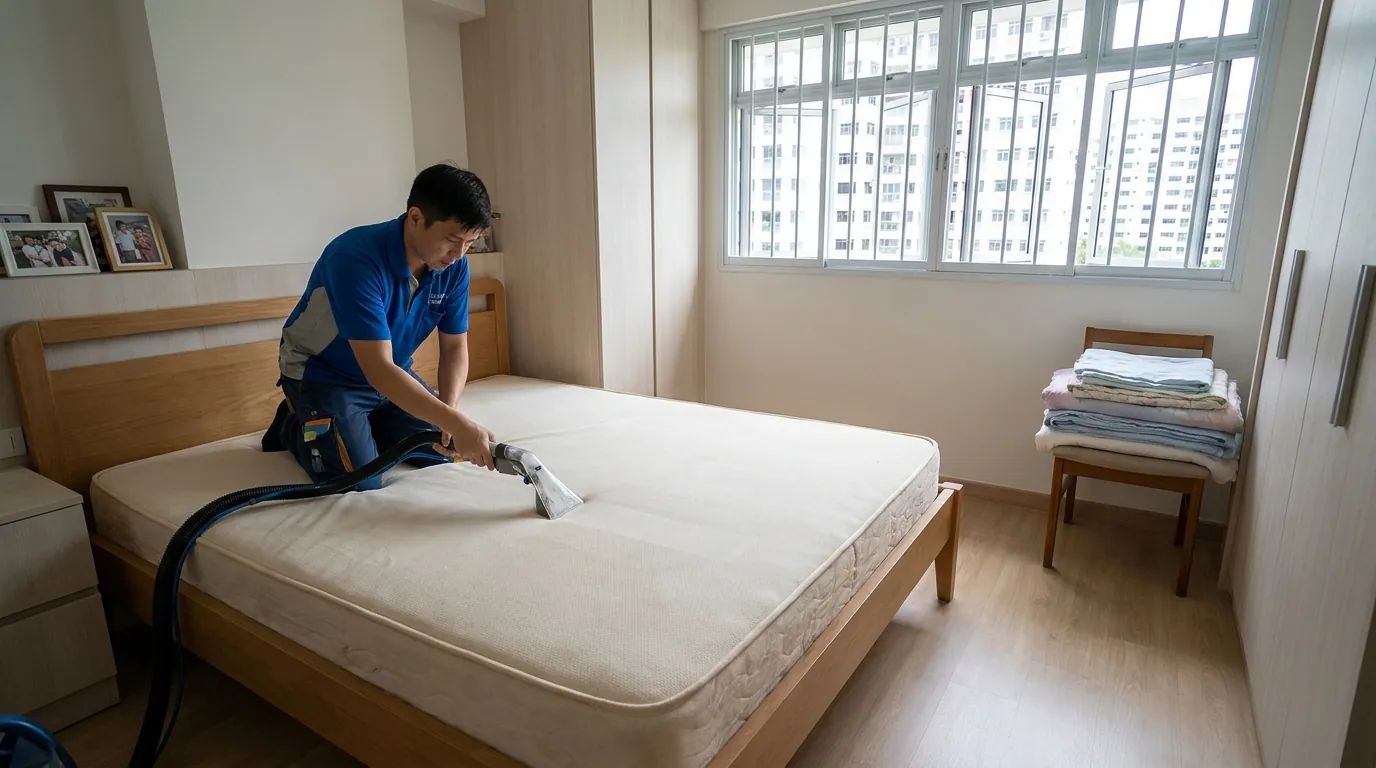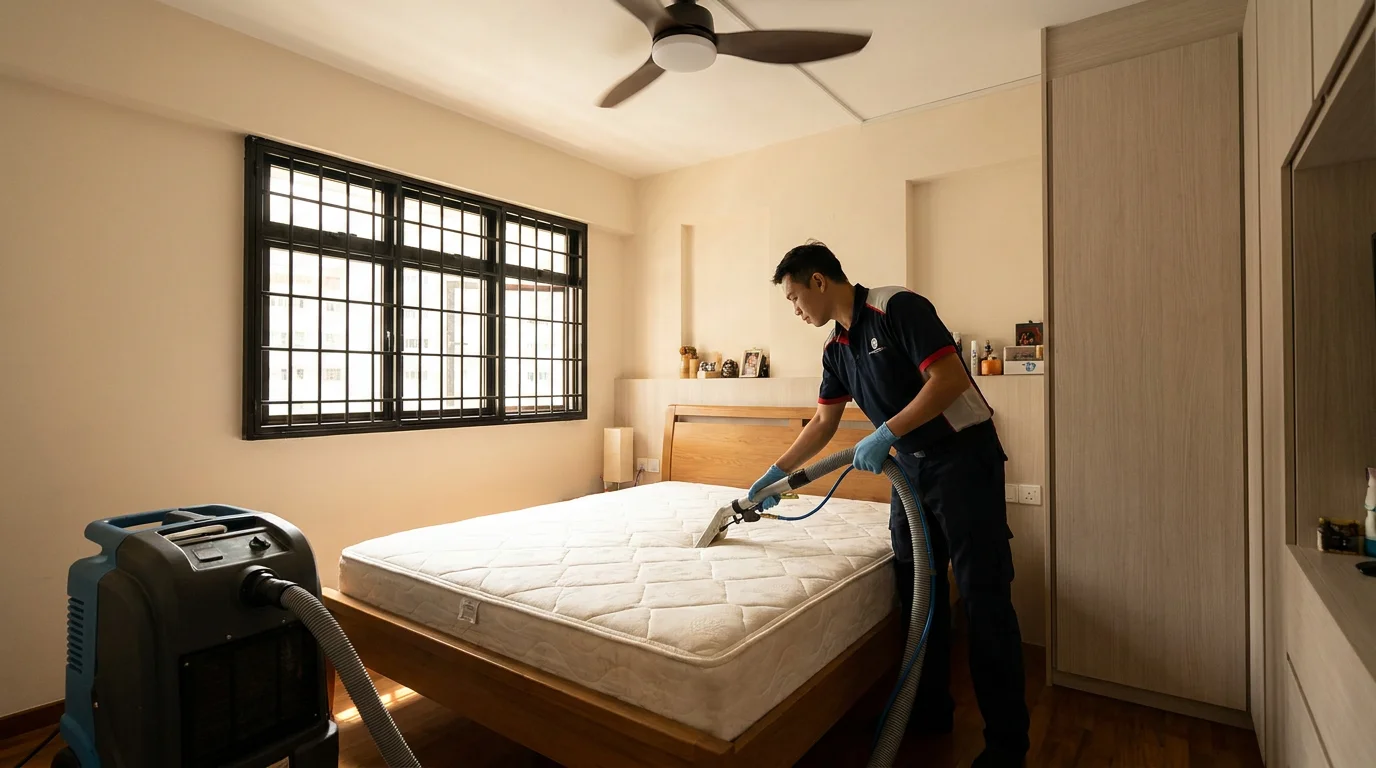
A Singapore mattress fights a climate most cleaning advice was never written for. Singapore's mean annual relative humidity is around 82%, with mornings routinely above 90% before the day's heat burns it off.[1] A mattress absorbs sweat every night and, in that humidity, rarely gets the chance to dry out fully before the next one. That trapped moisture is the starting point for dust mites, the amplifier behind stains and bed bug activity, and the cause of the musty smell that creeps into an old mattress. This guide is the hub for all of it: the science, a two-minute risk check, and links to the full guide for each specific problem.
Why a Singapore mattress is a different problem
In a drier climate, a mattress that soaks up sweat overnight gets a chance to release that moisture back into the air during the day. Singapore's humidity doesn't fall far enough for that to happen reliably; even the driest part of the afternoon typically sits around 60%.[1] Layer on an air-conditioned bedroom that swings between cold and humid, and the foam and quilting inside a mattress stay damp at a microscopic level for most of its life. That's not dirt you can see. It's the condition every other problem on this page grows out of.
The dust mite problem, specifically
Dust mites are microscopic creatures that feed on shed human skin cells, and they thrive once relative humidity climbs above roughly 50%, a threshold most Singapore bedrooms clear every day of the year.[2] They aren't the mites themselves that trigger reactions; it's the proteins in their waste and body fragments, which build up in a mattress that's never been deep cleaned and get stirred into the air every time someone lies down. For anyone with allergies or asthma, that means nightly exposure to the allergen right where they breathe for eight hours. A body of research put together by allergy specialists lists dust mite debris as one of the most common year-round indoor triggers for sneezing, a blocked nose, itchy eyes, and for asthma sufferers, tightness in the chest.[2] Our dust mite guide goes deeper into the warning signs and why vacuuming alone barely touches them.
Check your mattress's risk level
Answer honestly and you'll get a straight read on where your mattress sits, and which guide to read next.
Four issues, one root cause
These read like separate problems, but every one of them is humidity doing the same thing to a mattress that never fully dries. Here's the short version of each, with the full guide linked.
Dust mites and allergens
Covered above: the allergen load builds silently and is invisible to the eye. This is the one most likely to affect sleep quality and daytime symptoms even when the mattress looks spotless. Full detail in the dust mite guide.
Bed bugs
A different pest with a different fix: bed bugs are killed by sustained heat above 60°C, not by cleaning solution, so pest control has to come before or alongside a clean, never instead of it. Our bed bugs guide explains how to tell an infestation apart from ordinary dust mite irritation and why the treatment order matters.
Stains
Sweat, blood, and the occasional accident all sit differently in the fibres, and the humidity here makes an untreated stain set faster and smell worse than it would in a drier climate. The right agent for each stain type, plus what to avoid, is in the stain removal guide.
Odour
The same trapped-moisture mechanism that causes a musty sofa causes a musty mattress: bacteria feeding on absorbed moisture and body oils, releasing the smell as a by-product. It's the same science covered in our sofa odour guide, and the fix is the same too, extraction that physically pulls the residue out rather than a spray that just masks it.
What water extraction actually removes
A mattress can't be soaked the way a rug can, so the process is calibrated for a large foam item that has to be dry and sleepable the same day. A cleaning solution is worked into the surface, the extraction machine draws it straight back out along with the suspended dust, skin cells, and allergen debris, and the mattress finishes with a dust-mite sanitisation pass. Nothing is left to soak in, which is why the mattress is safe to sleep on again the same night once it's dry.
Room-temperature, not steam. Steam sanitises the surface but doesn't pull anything out of the foam. Extraction is the only step in the process that physically removes what's living inside the mattress rather than just treating what's on top of it.
What mattress cleaning costs in Singapore
Priced by size, with dust-mite sanitisation included on every clean, no separate charge for it:
| Mattress size | Price |
|---|---|
| Single | S$80 |
| Super Single | S$85 |
| Double | S$90 |
| Queen | S$100 |
| King | S$110 |
A S$50 minimum job fee applies, which every mattress size clears on its own. Every size, and what to expect on the day, is on our mattress cleaning page; the fixed rug rate for the same visit is on the full price list. A normal household is fine on a 12-month cycle; tighten that to every 3 to 6 months if anyone in the home has allergies, asthma, or eczema, or if the mattress is holding a visible stain or smell. The deeper cost-and-process breakdown, with an instant price calculator, is in our mattress cost guide.
Every mattress and bedroom guide, in one place
This page is the hub. Here is the full library for the bedroom:
- Mattress cleaning: cost, process, how often · with an instant price calculator
- Mattress stain removal · the right agent for each stain
- Bed bugs in your mattress · bed bugs vs dust mites, and treatment order
- The dust mite problem · the health case for deep cleaning
- Why does my sofa smell? · the same humidity mechanism, for sofas
- Post-renovation cleaning · fine dust in a brand-new mattress before first use
- Upholstery cleaning: the complete guide · every soft furnishing, one hub