The right sofa cleaner is decided by a small tag under your seat cushion, not by the label on the bottle. That tag carries a letter: W, S, WS or X. Buy to match the letter and most new marks come out. We clean sofas for a living and do not sell cleaning products, so nothing below is a pitch for a bottle. Looking for someone to clean the sofa for you? Our sofa cleaning service page has the prices and booking.
What does the letter on your sofa's care tag mean?
Lift a seat cushion and look for a fabric label on the platform or along a seam. Castlery's Singapore care guide tells owners to check the code on it, and makers such as Mayer Fabrics and Ashley Furniture publish what each letter allows.
- W
- Water-based cleaner only. A water-based foam or upholstery shampoo, or the foam from a mild detergent. Ashley adds a warning not to overwet.
- S
- Solvent only. A water-free dry-cleaning solvent. No water, so no dish soap, no machine and no steam.
- WS
- Either kind. A water-based cleaner or a mild solvent.
- X
- No liquid at all. Vacuum or brush lightly.
Which cleaner suits your sofa and your stain?
Pick the letter on your tag, then the kind of mark.
What types of sofa cleaner can you buy?
Five kinds turn up when people shop for one. Four have a place. One does not.
Foam and spray upholstery cleaners
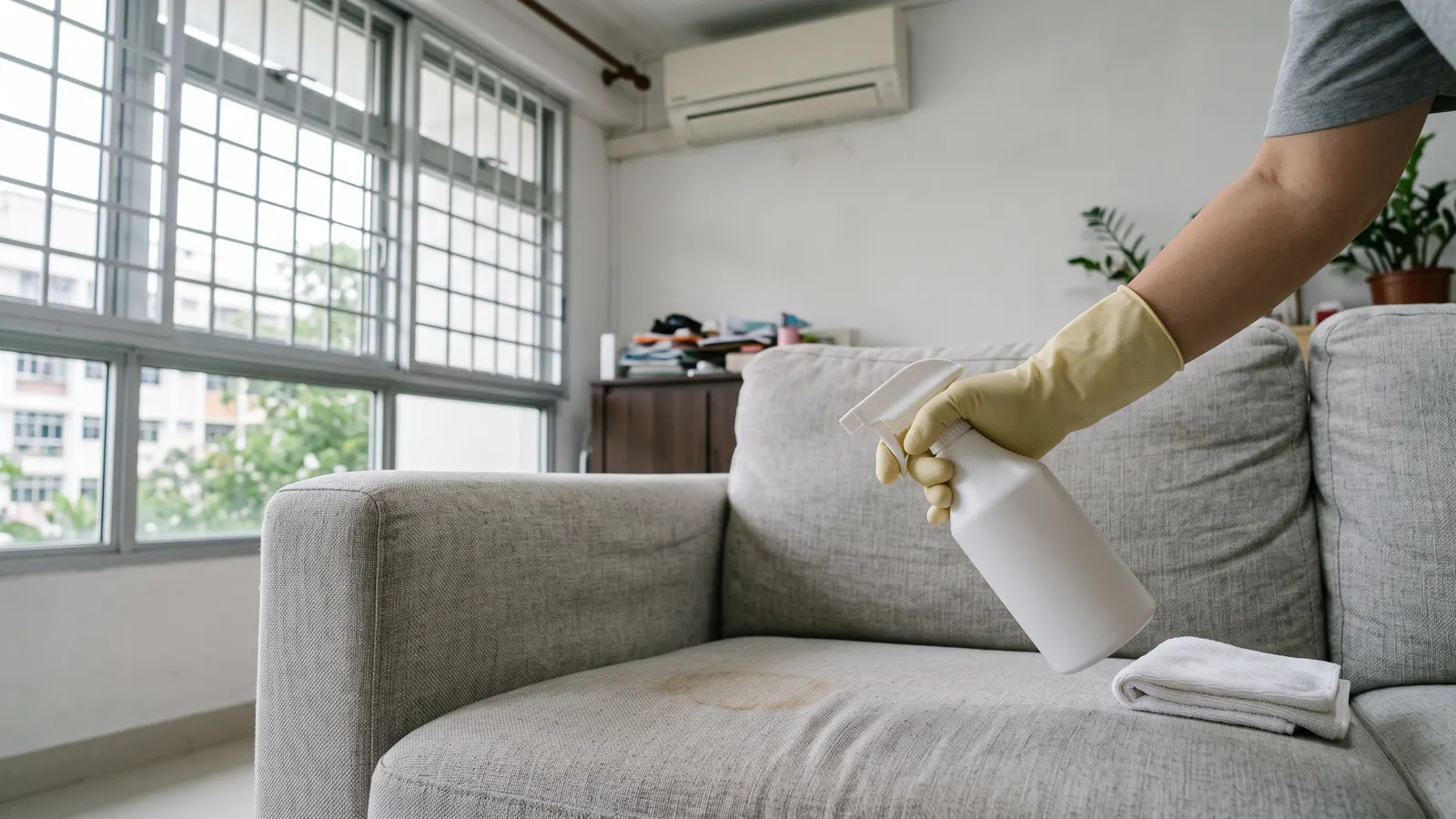
For W and WS fabricThe cans and trigger bottles sold as upholstery or fabric cleaner. On water-safe fabric they lift a new mark well enough. The catch is the soapy film they leave, which is why our how-to guide says to skip supermarket stain sprays. One is fine on a single new mark if you wipe the patch afterwards with a cloth dampened in plain water.
Dish-soap solution
For W and WS fabricMayer's instructions for W fabric ask for only the foam from a mild detergent, not the liquid. For carpet spots, the Carpet and Rug Institute gives a ratio of a quarter teaspoon of dishwashing liquid to one cup of water and says never to mix it stronger. We treat that as the ceiling for a sofa too. Whisk it and lift the foam off the top with a white cloth.
Solvent spot cleaners
For S and WS fabricWater-free products, usually labelled as dry-cleaning solvent. Dab one on with a white cloth. Ashley's S code says not to saturate the fabric, and Mayer says to use solvent only in a well-ventilated room.
Portable spot-cleaning machines
For W and WS fabricA small tank machine that sprays cleaner, scrubs, then sucks the dirty water back out. Nothing else here removes liquid from the fabric. One model sold in Singapore, the Tineco iCarpet Spot, was on sale at S$149 (usual price S$169) on HipVan at the time of writing (3 Oct 2026). Either price is more than one professional clean of a 3-seater, so it pays off mainly where spills are a weekly event.
Steam mops
SkipA steam mop is a floor tool. On a sofa it pushes heat and moisture into the cushion and has no suction to pull anything out. Even Kärcher Singapore's bed-bug steaming advice is to treat only the surface of upholstered furniture so that leftover moisture can dry fully. Singapore's mean relative humidity is around 82%, and the US EPA says water-damaged items should be dried within 24–48 hours to prevent mould.
Why does a cleaned patch get dirty again so fast?
Soap left in the fabric keeps clinging to whatever lands next. The Carpet and Rug Institute says as much about carpet: spot removers can leave residues that attract soil.
Mayer's fix is to rinse promptly with clean water. On a sofa, that means going over the patch two or three times with a cloth dampened in plain water, pressing a dry towel on in between, then putting a fan on it. A cloth gets only some of the soap out. Our own process ends with a clear-water rinse that is extracted back out.
How do you patch test a sofa cleaner?
Castlery says to try any shampoo or spot cleaner on a less visible area first, and Mayer writes a pretest into its instructions for W, S and WS fabric. The underside of a seat cushion works. Put on a little cleaner, blot with a white cloth and let the spot dry under a fan. Colour on the cloth or damage to the fibres, the two signs the Carpet and Rug Institute lists for carpet, means that cleaner is wrong for your fabric.
Once a cleaner passes, our step-by-step guide to cleaning a fabric sofa covers the vacuuming, blotting and drying. That guide mists the mix on from a spray bottle. The foam method above puts less water into the fabric, so use it if you are unsure.
When should you stop and call a professional?
A bottle or a small machine deals with a new mark near the surface. More product will not fix these:
- A stain that is weeks old, or one already scrubbed a few times.
- Liquid that went through to the foam. Pet urine is the usual one. Our sofa odour guide explains why the smell keeps coming back.
- A sofa that is dull or grey all over. Mayer's own advice is to use a professional furniture cleaning service at that point.
- An S or X tag, or a failed patch test.
For the first three, Upward cleans fabric sofas at your home by room-temperature water extraction, with a clear-water rinse so that no soap stays in the cushions and a hospital-grade sanitising pass included in the price. A fabric sofa usually dries in 5 to 7 hours with a fan or the aircon on.
Extra seats and ottomans are S$20 each, and the minimum job fee is S$50. See the full price list.
If your tag says S or X, WhatsApp us a photo of it before you book. Extraction is a wet method. If it does not suit your fabric we will say so, and you will need an upholstery dry-cleaning specialist instead.
None of these cleaners belong on leather, which we hand clean and condition. Our leather sofa care guide covers home care. Upward does not do mould remediation either, so visible mould goes to a mould remediation specialist.